Reducing overwhelm through thoughtful planning, coaching and practical support
Support That Works
With You
Not Against You
Personalized planning, practical support, and neurodivergent-affirming coaching designed around real life, individual needs, and the way you function best.Coaching is for Autistic and ADHD adults. Planning and practical support services are available to anyone seeking thoughtful, individualized support.
🔎 Research & Planning Services
👥 Parent & Family Support
🏠 In-Home Support
💬 Coaching

WHAT THIS IS
Wired Well Support offers thoughtful planning, practical support, and neurodivergent-affirming coaching designed to reduce overwhelm and make everyday life feel more manageable.Some people come looking for space to process, reflect, and better understand themselves. Others need practical support with planning, organization, travel, or navigating family life.Whatever brings you here, support is tailored to your situation rather than following a one-size-fits-all approach.Support is collaborative, flexible, and built around what will genuinely make life feel more manageable,not around rigid systems or one-size-fits-all solutions.
About Me
I offer neurodivergent-affirming coaching for ADHD and autistic adults who want to better understand and connect more deeply with their neurodivergent identity, including the strengths, patterns, and ways of thinking that come with it, alongside support for the challenges that can show up in daily life.My aim is to create an inclusive, confidential, and non-judgmental space where you can show up as yourself, explore ideas, and talk through what matters in a way that feels grounded, steady, and supported.I don’t believe Autistic/ADHD people are broken or failing at life. I see their neurodivergence as a valid way of thinking, processing, and experiencing the world, with its own strengths, patterns, and ways of processing, while also recognizing that there can be real challenges. My approach is strengths-based, while making space for the difficulties that can come with navigating systems and environments that were not designed with our brains, needs, or ways of processing in mind.My approach is collaborative and practical, grounded in what everyday life actually feels like, including how attention, energy, motivation, and overwhelm can shift in different ways for different people.Many Autistic & ADHD people spend a lot of time masking or trying to fit into environments that feel overly rigid or performative. I want this space to feel more human. That can include reflection, honesty, frustration, awkwardness, and sometimes humor too.I don’t believe spaces for growth or self-understanding need to feel heavy all the time. Moments of lightness, relief, and genuine connection can matter too.Sessions are conversational and process-led, following your thinking as it unfolds in the moment rather than relying on rigid agendas. I work with verbal processing and reflective exploration, and support you in making sense of what emerges so we can gently translate it into clarity and practical direction where helpful.Rather than focusing on doing more or pushing through difficulty, I focus on slowing things down together to understand what is getting in the way when things feel stuck or hard to start.My work is influenced by somatic processing, attachment theory, and a neurodivergent-affirming understanding of safety, regulation, and connection in everyday life.
Training & Certifications
Autism Coaching Certification (Efficient Coach)
ADHD Coaching Certification (Efficient Coach)
Accredited through ICAHP, IPHM, CMA, CPD, and NCCAP
Understanding Implicit Demands in PDA Communication: Practical Tools for Caregivers & Professionals (webinar, PDA North America)
Ongoing continued education in neurodivergent-affirming coaching approaches
Professional Memberships
Autism Professional Coaching Association (APCA)
![Association of Professional Coaches [APC] - https://www.associationofprofessionalcoaches.com](https://aopc.wildapricot.org/resources/Pictures/APC_badge_green_dom_blue_on_white.png)
An Intersectional Approach
Being born and raised in Puerto Rico and later moving to the U.S. has shaped how I understand belonging. I’ve spent a lot of time in spaces where I didn’t fully fit, culturally, linguistically, or in terms of values, and those experiences have shaped how I understand the feeling of being “between worlds.”I recognize that the experience of ADHD and autism doesn’t exist in isolation. Culture, language, identity, family expectations, and experiences of belonging can all influence how someone understands themselves and how they experience the world. For many neurodivergent people, these layers can also affect how their Autism or ADHD is understood, expressed, or even recognized in the first place.This work may particularly resonate with Autistic & ADHD adults navigating cultural identity, belonging, late diagnosis, masking, or the experience of feeling “between worlds” in different ways. Many people who feel drawn to this space have had their neurodivergence overlooked or misunderstood, or have spent years navigating cultural expectations and systems that were not built with them in mind. This includes women, BIPOC and Latine clients, people from immigrant or bicultural backgrounds, and other marginalized neurodivergent adults.I offer support in both English and Spanish. Some clients feel more comfortable in one language, while others naturally move between both. Language is often tied to identity and how safe or understood someone feels, and I aim to make space for that.As a queer Latina, I also understand the importance of being able to bring the different parts of yourself into the same space rather than feeling like you have to separate or explain them. My goal is to create a space where those intersections can be acknowledged and where you can show up as your whole self.You don’t need to have everything figured out before starting.We can begin wherever you are.
WHAT SUPPORT CAN LOOK LIKE
Sessions are collaborative and flexible. You don’t need to come in prepared or organized unless that helps you feel more grounded or supported.You’re welcome to bring anything that helps you feel more comfortable or focused during sessions, such as stimming tools (for example: fidgets, textured objects, or other sensory tools), notebooks for doodling, knitting, or anything else that supports your attention, comfort, or regulation.Support can look different depending on what you need:💬 Coaching• Feeling overwhelmed, stuck, mentally overloaded, burnt out, or emotionally drained•Difficulty starting, switching, or finishing tasks•Building routines, systems, boundaries, and self-care that work with your actual capacity•Understanding your focus, energy, motivation, strengths, values, and patterns•Navigating ADHD and autism in daily life, including after a late discovery•Making sense of past experiences, identity shifts, masking, and unmasking•Reconnecting current experiences with earlier patterns that may not have had language before•Self-criticism, shame, or the feeling of always being behind
Practical Support
🏠In-Home SupportSupport may also include practical, hands-on assistance such as:• De-cluttering and organizing your home
• Creating systems that feel realistic and sustainable
• Body doubling while working through tasks that feel difficult to start or finish
• Reducing decision fatigue
• Working together in your physical environment in real timePlanning Services
✈️Travel PlanningSupport can also look like reducing the mental load of planning travel by:• Researching flights and accommodation options
• Comparing and narrowing down choices
• Building personalized itineraries
• Organizing logistics and moving parts
• Supporting decision-making throughout the process👥 Parent & Family SupportParents and caregivers may be looking for:• support understanding communication
• sensory needs and behavioral patterns
• shifting expectations away from neurotypical standards
• This may be explored through consultations
• A structured family communication process depending on what feels most helpful

BODY DOUBLING
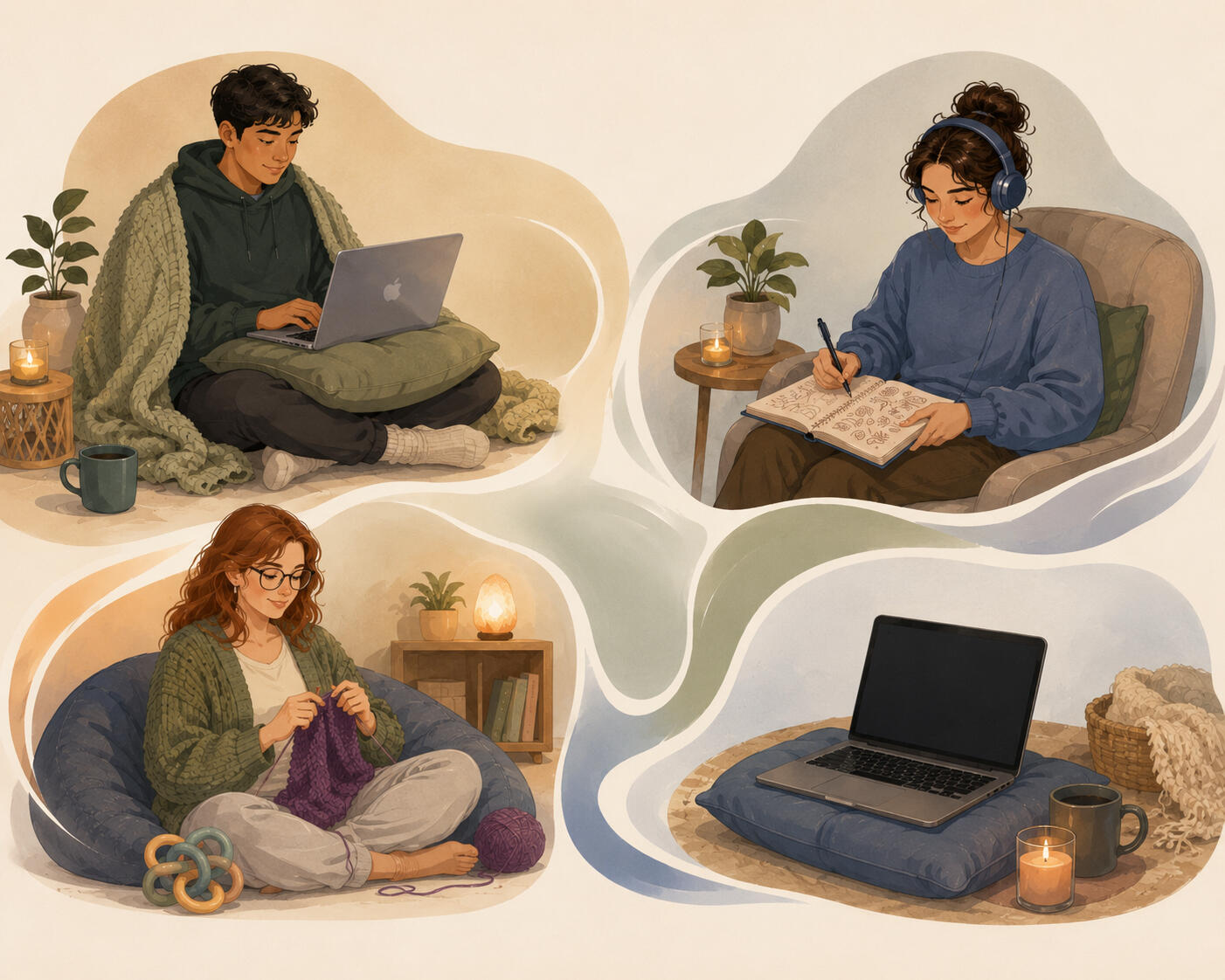
Body Doubling SupportStructured work-with-me sessions to help with focus, task initiation, and follow-through.We start with a brief check-in, then you work while I stay present for accountability and support.This can help with:getting started on tasks that feel hard to begin
staying focused without drifting away
reducing overwhelm while working
finishing tasks with support present
Behind the Mask: A Neurodivergent Community
A low-pressure virtual space where neurodivergent adults can connect, reflect, and share experiences in a supportive small-group environment. This space is designed to feel flexible and welcoming, without pressure to participate in any one specific way.Do you ever want to connect with other neurodivergent adults who just get it?Topics may include late diagnosis experiences, masking, identity shifts, relationships, work, routines, sensory experiences, burnout cycles, and navigating daily life as a neurodivergent adult.Participation styles are flexible, and listening quietly, using the chat, keeping cameras off, or speaking more actively are all welcome.Sessions are held once a month in a small-group format with a maximum of 12 participants to allow space for meaningful conversation and connection.Weekday and weekend options available.
Ways to Work Together
🧠15-Minute Check-In Sessions:
Brief support sessions for existing or returning clients. These are used for quick resets, reconnecting with what feels manageable, or clarifying next steps between ongoing sessions.🟡Coaching Sessions (30 min):
Structured support sessions offered within monthly packages (4, 6, or 8 per month). These sessions create space to reflect, process what’s currently happening, explore patterns, and work through daily life in a way that feels supportive and sustainable.These sessions can also be booked as standalone one-time sessions outside of a package for flexible, occasional support.🟠Deep Dive Sessions (60 min):Extended coaching sessions available for existing or returning clients. These sessions offer additional space for more layered topics, transitions, identity exploration, or situations that feel especially complex or difficult to untangle.🟢Body Doubling (30 min):
Focused co-working support included within monthly packages. These sessions provide shared structure and real-time support while you work on tasks that feel difficult to start, continue, or complete alone.🏡In-Home Support:In-person support available locally as structured, hands-on sessions held in the client’s home. These sessions include de-cluttering and organizing spaces such as kitchens, closets, bathrooms, and home offices, setting up simple functional systems, and working alongside you in real time to reduce friction and make it easier to get started with and move through what you’re working on in your environment.Sessions are 3-hour minimum and include travel within a defined local radius.🎭Behind the Mask: A Neurodivergent Community:
A low-pressure virtual space for neurodivergent adults to connect, reflect, and share experiences in a supportive environment. Participation styles are flexible, and cameras are always optional.
Planning Services
✈️ Travel PlanningStructured, neurodivergent-affirming travel support designed to reduce overwhelm and decision fatigue around planning trips.This includes researching flight and accommodation options, comparing choices based on your preferences, building clear itineraries, and organizing logistics so everything feels easier to follow and manage.Support is focused on turning travel ideas (or even just the feeling of needing a break) into a clear, organized, step-by-step plan that removes the need to navigate multiple tabs, decisions, or planning layers alone.Depending on the trip, this may range from simple single-destination getaways to more complex multi-stop or multi-city planning with higher logistical coordination.
Parent & Family Support
💬Neurodivergent Family Communication SupportA short-term, structured support process for neurodivergent children and their caregivers to better understand one another, strengthen communication, and reduce misunderstandings within the family system.This work is guided through a neurodivergent-affirming lens and may include caregiver sessions, child participation (when appropriate and comfortable), and joint family sessions focused on communication and relational understanding.
(5-session structured package)
🧠 Neurodivergent Parent ConsultationA focused consultation for parents and caregivers seeking clarity, guidance, and a neurodivergent-affirming perspective on their child’s behaviours, communication style, and needs.This session is designed to help parents better understand their child through a neurodivergent lens and begin shifting away from neurotypical expectations toward more supportive, realistic, and connected approaches.
Which Support Option is Right for You?
If you're looking for space to reflect, process, and better understand yourself, coaching may be the best fit.If you already know what needs to get done but getting started or staying on track feels difficult, body doubling may be more helpful.If you're feeling overwhelmed by planning a trip and want someone else to handle the research and logistics, Travel Planning Support may be the right place to start.If you're a parent or caregiver looking to better understand their child and would like guidance, reflection, and a deeper understanding of communication, behavior, and support needs through a neurodivergent lens, Parent Consultation may be the best fit.
If your family is looking for structured support around communication, understanding, and reducing misunderstandings within the family system, the Neurodivergent Family Communication Support package provides a short-term, guided process with space for both caregivers and children.If you're looking for connection with other neurodivergent adults rather than one-to-one support, Behind the Mask may be a good fit.If you benefit from hands-on support in your physical environment, in-home sessions offer structured, in-person work within your space. (Local to Massachusetts, US)If you're still unsure, book a free 20 min consultation and we'll figure it out together.

FAQ'S
1. Do I need to be organized or prepared before sessions?
No. You don’t need to come in with anything prepared unless that helps you feel more grounded. We can start wherever you are.2. Is this therapy or coaching?
This is coaching and practical support, not therapy or clinical treatment.Therapy typically focuses on diagnosing and treating mental health conditions, processing trauma, and working through deeper emotional or clinical concerns.Coaching focuses more on present-day support, reflection, and forward movement, with an emphasis on understanding patterns, building practical strategies, and navigating everyday life in a way that feels more manageable and supportive.While therapy often explores and processes the past in depth, coaching is generally more focused on understanding where you are now, what feels difficult or stuck, and what might feel helpful or possible moving forward.Coaching can work alongside therapy and other forms of support, but it is not a replacement for mental health care, crisis support, or clinical treatment.3. What if I don’t know what I need help with?
That’s completely okay. A lot of the work is figuring that out together over time.4. Who is this for?
This support is for neurodivergent adults, including ADHD and autistic individuals (diagnosed or self-identified), as well as highly sensitive people (HSPs) who resonate with feeling overwhelmed by environment, emotion, or daily demands.This work is for people who want more understanding, structure, and support in everyday life, and who are looking for approaches that feel flexible, non-judgmental, and adapted to how their brain actually works.5. How structured are sessions?
Sessions are flexible. We may focus on reflection, planning, problem-solving, or working through something in real time depending on what feels most useful that day.6. What’s the difference between coaching and body doubling?
Coaching focuses on reflection, understanding patterns, and planning. Body doubling is real-time support while you work on tasks.7. Can I reschedule or cancel sessions?
Sessions may be rescheduled or cancelled with at least 48 hours’ notice. With less than 48 hours’ notice, the session is considered used, as that time has been reserved specifically for you.In-home support sessions require at least 72 hours’ notice due to travel and scheduling logistics. With less than 72 hours’ notice, the session is also considered used.Packages run on a 1-month cycle starting from the date of purchase. Sessions are intended to be used within that period and can be scheduled flexibly throughout the month.Standalone 30-minute sessions and 60-minute deep dive sessions follow the same 48-hour notice policy and are intended as one-time bookings.If something unexpected comes up, you’re welcome to reach out. I understand that energy, capacity, and circumstances can shift, especially for neurodivergent clients.8. Refunds
Packages and one-time sessions are generally non-refundable once booked, as time is reserved specifically for you.If something isn’t working, you’re welcome to reach out so we can discuss what adjustments or options may be supportive moving forward.9. What does a session actually feel like?
Sessions are collaborative and flexible. There is no expectation to perform or come in a certain way. We may talk, reflect, plan, problem-solve, or work through something in real time depending on what feels most helpful that day.You don’t need to mask, organize your thoughts, or prepare anything in advance unless that helps you feel more comfortable.10. What happens if I can’t attend a community group session?
Attendance for group sessions is for the scheduled date and time. If you are unable to attend, you may request to transfer your booking to a future session, subject to availability. Transfers are not guaranteed and depend on space in future sessions.11. What if I get overwhelmed or shut down in sessions?
That is completely okay. We can slow down, pause, shift direction, or simplify what we’re working on. Sessions are designed to adapt to your capacity, not push through it.You’re also welcome to turn your camera off, take a break, or step away from the session if needed. If something feels like too much, we can adjust in the moment or pause and revisit it another time.We can also talk ahead of time about what support would feel helpful in those situations, or decide together as we go.12. Do I need a diagnosis to work with you?
No. You do not need a formal diagnosis. Many clients are self-identified or in the process of understanding their neurodivergence.13. How do I know if I’m ready?
You don’t need to feel fully ready. Many people begin coaching while feeling uncertain or overwhelmed. What matters is a willingness to explore support and try working with what’s currently difficult in your life.


© Wired Well Support. All rights reserved.